The Chisel and the Waveform: Where Mathematical Metrology Meets Elite Audio Craftsmanship
The Chisel and the Waveform
In the world of high-end audio mastering, there is a persistent friction between two schools of thought. On one side stands the digital purist, armed with cold, mathematical precision, viewing sound as nothing more than a series of ones, zeros, and discrete frequency coefficients. On the other side stands the romantic analog purist, relying entirely on intuition, hardware non-linearities, and the "magic" of vacuum tubes and transformers.
At Iron Pen Studios LLC, we reject this division. We operate under a different philosophy: Faithful Representation.
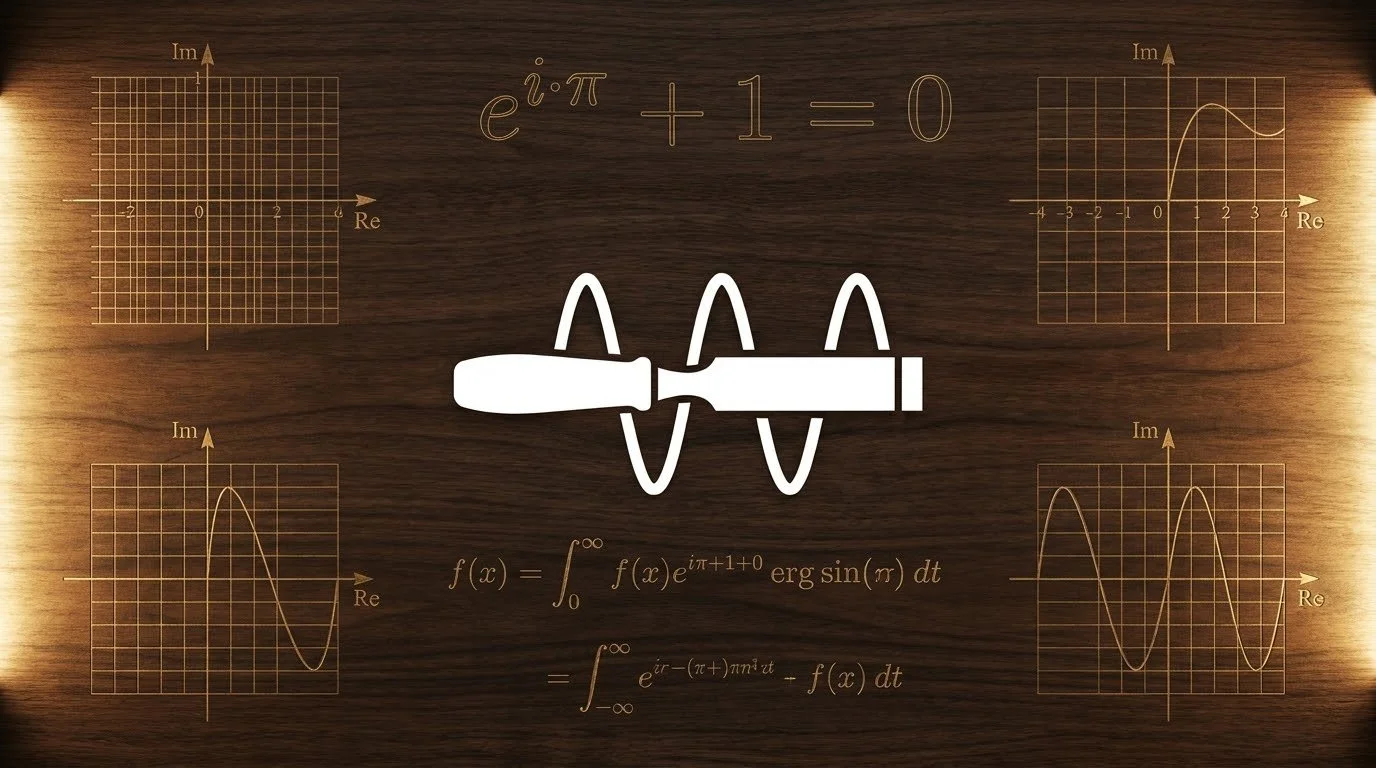
We believe that true master engineering is the point where advanced mathematical metrology intersects with elite, artisanal craftsmanship. This synthesis is not just a workflow—it is hardcoded into our visual identity. Our brand mark, the Chisel-Waveform Zero-Crossing Symbol, is a visual tribute to this unity, deeply rooted in the most beautiful equation ever written: Euler's Formula.
1. The Geometry of the Wave: Mapping Euler’s Formula
To understand the Chisel-Waveform, one must first understand the geometry of sound. In mathematical physics, Euler’s Formula is written as:
$$e^{i\theta} = \cos\theta + i\sin\theta$$
This elegant expression bridges two seemingly unrelated worlds: the infinite, circular rotation of a point in the complex plane (represented by the exponential $e^{i\theta}$) and the periodic, oscillating rise and fall of a wave in the time domain (represented by the trigonometric sine and cosine functions).
A pure sound wave—a sine wave—is not a random squiggle. Mathematically, it is the real-time, two-dimensional projection of perfect circular motion. As time flows, the complex exponent rotates around the unit circle, and its shadow traces the perfect peak, slope, and valley of the audio wave.
Our standalone brand mark captures the exact point where this continuous oscillation intersects with the horizontal time axis: the zero-crossing point.
$$e^{i\pi} + 1 = 0$$
When the angle $\theta$ reaches $\pi$, the imaginary sine component collapses to zero, and the equation resolves into Euler's Famous Identity. Visually, this is the precise moment the wave crosses the zero-amplitude line. In digital signal processing (DSP), editing at the zero-crossing point is the absolute technical boundary of clean editing. It guarantees that our cuts, fades, and processing boundaries occur at zero-energy states, preventing the digital transients, clicks, and pops that plague lesser, automated mastering mills.
2. The Mathematical Engine of Audio Metrology
This mathematical foundation is not merely symbolic; it is the active engine driving our daily operations. In our forensic dialogue restoration and broadcast loudness compliance workflows, Euler's Formula is the mathematical cornerstone of the Fourier Transform.
Raw, real-world audio recordings—whether they are damaged municipal field tapes or corporate podcasts—are messy, chaotic mixtures of frequencies. To clean them, we must decompose them. The Fourier Transform accomplishes this by multiplying the time-domain audio signal by a complex exponential:
$$X(f) = \int_{-\infty}^{\infty} x(t) e^{-i 2 \pi f t} dt$$
By using Euler’s Formula to break the complex exponential into sines and cosines, the algorithm acts as a digital "spectrogram prism," converting raw, tangled time-domain waves into a highly detailed frequency matrix.
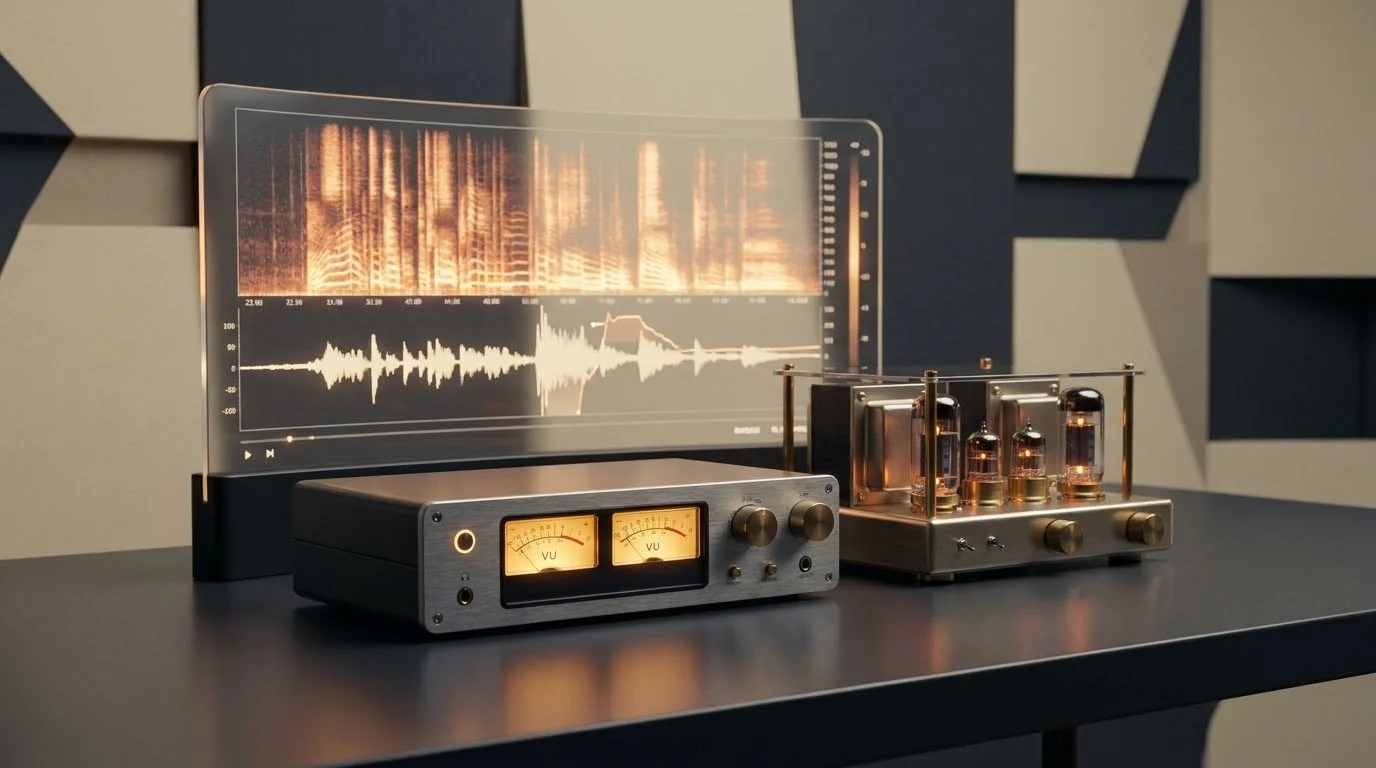
Inside our digital workstation, using tools like iZotope RX 12 Standard, we use this Fourier analysis to visually inspect noise. We can see the exact frequency of an air conditioner's hum, a camera's high-frequency whine, or a room's resonance, and surgically "carve" them out of the spectrogram. Euler's Formula is the digital chisel that separates noise from the human voice.
3. The Chisel: The Artisan's Tool
If the waveform represents mathematical metrology, the Chisel represents the tactile, physical, and highly focused human element—the elite artisan.
Once forensic restoration has cleaned the digital file with mathematical transparency, the audio signal is routed out of the digital domain. We do not rely on flat, generic software emulations to finish our masters. Instead, the signal is imprinted with organic warmth through a world-class, physical analog signal chain: the parallel filter networks of the Manley Massive Passive EQ and the discrete, dual-stage compression of the Shadow Hills Mastering Compressor Class A.
Routing sound through physical copper, transformers, and vacuum tubes introduces subtle, pleasing non-linear phase shifts and even-order harmonic saturation. Unlike digital emulations, which attempt to approximate these behaviors with flat mathematical models, physical hardware naturally rounds off harsh, brittle frequencies. This adds a three-dimensional depth, density, and vocal authority that listeners don't just hear—they feel.
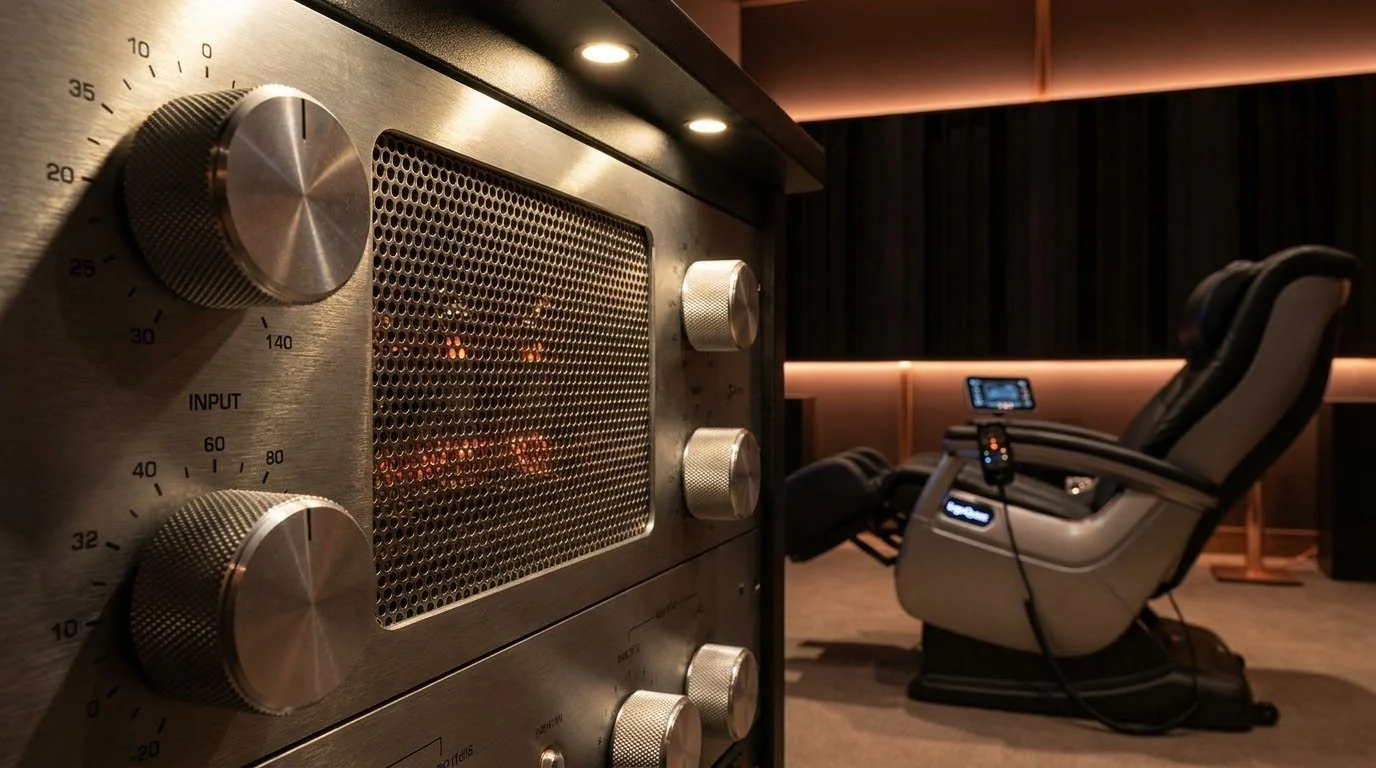
This artisanal process requires hyper-focused, unhurried attention. Auditory fatigue is the primary driver of digital mastering errors, which is why our engineering operations are strictly governed by a 15-Hour Weekly Physical and Operational Pacing Boundary. Operating from a customized, medical-grade ErgoQuest zero-gravity workstation reclined in a neutral-spine posture, we eliminate physical fatigue and spinal compression. This specialized ergonomic environment preserves clinical auditory stamina, ensuring that every single track in our queue receives the uncompromised cognitive quality control it deserves.
4. The Synthesis of the Logo
The Chisel-Waveform logo is the perfect visualization of this operational loop:
The Chisel: Represents the hands-on, hardware-driven physical mastery that carves away digital artifacts and shapes raw sound into art.
The Waveform: Represents absolute metrological correctness, ensuring all edits, sample-rate conversions, and loudness normalizations conform to exact federal standards, such as ATSC A/85 broadcast loudness limits of -24 LUFS.
The Alignment: Together, they prove that elite audio engineering is neither purely artistic intuition nor cold digital calculations. It is a unified discipline where advanced science serves the human soul.
When prime contractors, government Public Information Officers (PIOs), and serious independent artists look at our brand mark, they are not just looking at a logo. They are looking at a promise: uncompromising technical compliance, executed with physical, artisanal mastery.
Interested in experiencing this precision firsthand? We invite government contracting officers, agency representatives, and B2B clients to schedule a live, virtual 15-minute "Show Me, Don't Tell Me" demonstration. Watch us surgically paint out background noise in real-time, walkthrough our physical analog signal path, and verify our Section 508 and broadcast loudness compliance pipelines.
Decoupling the Laws of Physics: Engineering an STC 72 Analog Mastering Environment
It All Begins Here
In the world of high-fidelity mastering, silence is not merely golden—it is a measurable physical requirement. To achieve "Faithful Representation"—the uncompromised transmission of an artist’s sonic intent—the listening space must be acoustically neutral. Sound traveling through the physical world behaves like water, taking the path of least resistance through studs, drywall, and concrete. Standard commercial partition walls (with an STC rating of 35 to 40) allow low-frequency pressure waves to bleed into the environment, creating acoustic bridging that compromises monitoring accuracy.
To solve this, Iron Pen Studios engineered a bespoke STC 72 decoupled acoustic shell inside a 231-square-foot facility footprint. This technical deep dive breaks down the structural physics and concrete engineering required to isolate our physical analog mastering chain from the outside world.
1. The Decoupling Principle: Avoiding the "Triple-Leaf" Trap
Many general contractors assume that adding more layers of drywall with air spaces between them will linearly increase sound isolation. In acoustic physics, this often does the exact opposite, creating a destructive phenomenon known as the Triple-Leaf Effect.
An acoustic "leaf" is any dense mass separated by an air cavity. When you build a three-leaf wall (mass-air-mass-air-mass), the middle leaf acts as a diaphragm, trapping air springs on either side. This drastically raises the system's resonant frequency (f0), rendering the wall functionally transparent to critical low-end frequencies (40Hz to 100Hz) where kick drums and bass transients reside.
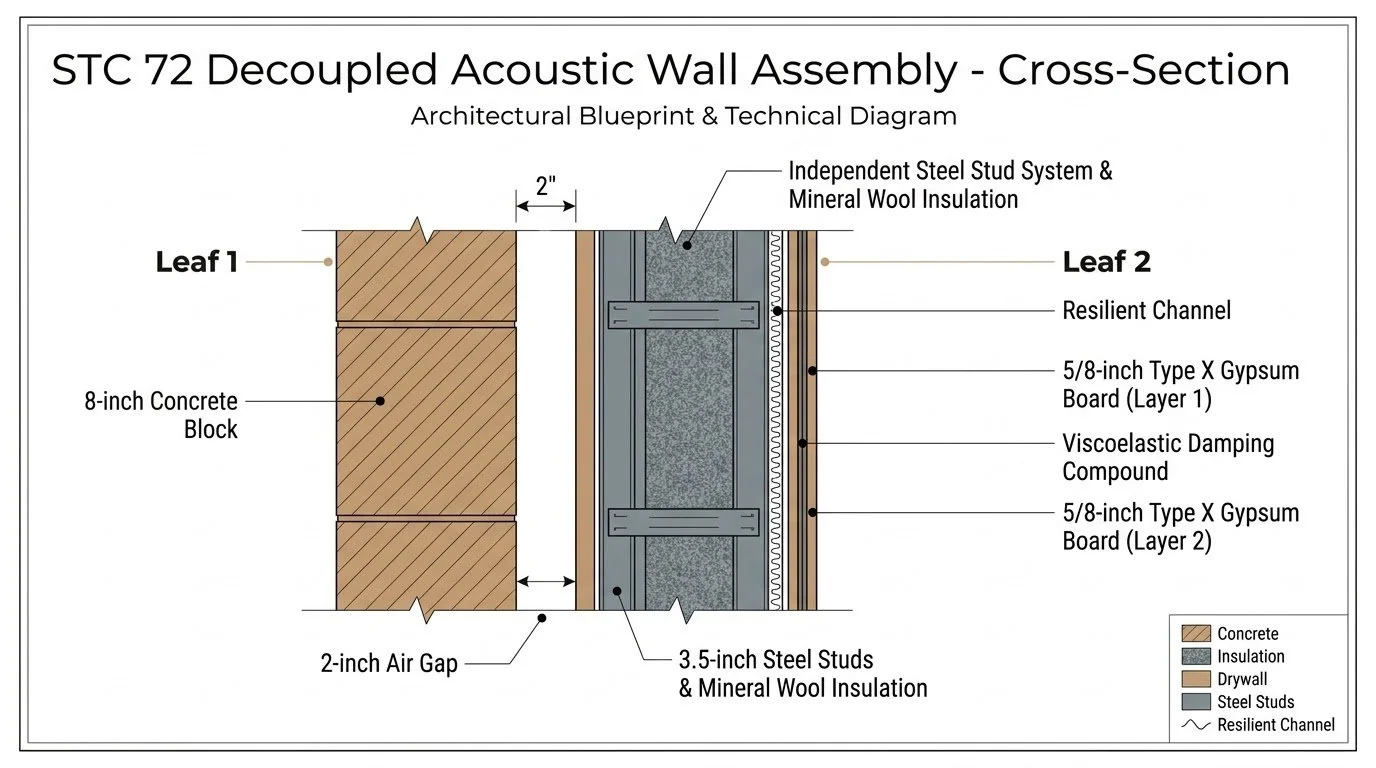
To achieve our STC 72 target, we designed a strict two-leaf mass-air-mass system:
[LEAF 1: Heavy Mass]        [AIR CAVITY]        [LEAF 2: Decoupled Inner Mass]
8" Concrete Block  ──>  3.5" Independent Steel Stud  ──>  Dense R-13 Insulation
                            (2" Air Gap)               1/2" Drywall Core
By maintaining exactly two massive leaves separated by a wide air gap, we pushed the fundamental resonant frequency of the wall assembly safely below the audible spectrum, isolating the room down to the lowest octaves.
2. Structural Metrology: The Mass-Air-Mass Formula
We calculated our sound transmission loss using the standardized Mass-Air-Mass resonance equation:
f0=115⋅d⋅m1⋅m2m1+m2
Where:
m1 is the surface density of Leaf 1 (8-inch hollow-core concrete masonry units).
m2 is the surface density of Leaf 2 (drywall core).
d is the depth of the decoupled air cavity (including the physical air gap and stud depth).
By utilizing high-density concrete blocks as our outer leaf and separating our inner steel framing by a 2-inch physical air gap, we maximized the variable d. This structural separation ensures that heavy airborne low-frequency waves lose their kinetic energy before they can physically bridge to our inner drywall leaf.
3. Concrete Leveling & Isolation Joint Engineering
A heavy analog mastering loop demands an absolutely stable structural foundation. Sound vibrations easily bridge through solid concrete floors. To decouple our room's floor from the home's primary foundation, the build required a two-step concrete layout:
The 4-Inch Leveling Slab: We poured a custom 4-inch concrete leveling slab to create a perfectly flat, level base for our decoupled walls and workstations.
Acoustic Isolation Joints: We ran a high-density, closed-cell neoprene isolation joint around the perimeter of the inner slab. This physical gasket breaks the contact point between the new flooring and the existing structure, absorbing structural impact noise and preventing low-end energy from traveling into neighboring residential framing.
4. High-Performance Openings: CGI Impact Glass & Manual Curtains
Every opening in an acoustic shell is a potential flanking path. Standard windows act as structural weak points, letting in street noise.
To maintain the integrity of our STC 72 envelope while satisfying emergency safety requirements, we integrated a 5.7-square-foot CGI impact-rated egress window. CGI's multi-layered laminated glass provides thick, variable-density mass that disrupts the transmission of external sound.
To control high-frequency reflections and light leakage off the glass during sensitive mastering sessions, we installed a custom, manual acoustic curtain over the opening. This setup allows us to easily control the room's decay time while completely avoiding the electromagnetic interference and mechanical noise of motorized tracks.
5. The Aesthetic & Ergonomic Goal: Peak Cognitive Accuracy
Achieving an STC 72 isolation rating is not just about keeping outside noise out—it is about creating a pristine acoustic canvas inside the room. This silent, isolated environment allows us to operate at the peak of cognitive accuracy.
Within this quiet space, we run our specialized mastering loop:
Acoustic Treatment: Freestanding, high-absorptive panels paired with a low-profile, 2-inch-thick ceiling cloud suspended with a 1-inch air gap to eliminate vertical early reflections.
The Monitoring Chain: A pair of world-class Focal Trio6 ST6 monitors aligned in a calibrated stereo-only field to guarantee phase accuracy and translation across commercial systems.
The Ergonomics: An ErgoQuest zero-gravity workstation designed to suspend the body and decompress the spine during long listening sessions, keeping the mastering engineer's ears and mind fresh, alert, and hyper-focused.
By engineering out physical, structural, and acoustic fatigue at the fundamental level, Iron Pen Studios delivers pristine, broadcast-ready mastering that stands up to the most demanding regulatory and artistic standards.
Behind the Sound: Transparent Workflows for Public Information Excellence
Behind The Sound
1. Introduction: The Mission of Clarity for PIOs
Iron Pen Studios operates with a singular mission: to provide high-fidelity audio solutions that bridge the gap between complex forensic restoration and the public’s need for transparent information. Our "Company Description" is rooted in the SBA framework for operational excellence: we empower Public Information Officers (PIOs) with the technical clarity required to structure, run, and grow their public messaging initiatives with confidence.
In accordance with the "Three Kinds of Customers" methodology, we identify the PIO as both the primary Buyer and User. As Users, PIOs require workflows that make their professional lives easier and help them succeed in delivering intelligible evidence. As Buyers, they seek to improve outcomes, specifically regarding public trust, agency rankings, and production quality. Our core purpose is to eliminate technical ambiguity, ensuring that forensic complexity never serves as a barrier to public accessibility.
2. The Operational Blueprint: Why Live Demonstrations Matter
The "Live Demonstration Workflow" is the Unique Selling Proposition (USP) of Iron Pen Studios. This workflow transforms the "Operational Plan" from a closed-box process into a transparent partnership. We utilize a rigorous "Go/No-Go" decision-making framework based on the SCORE Feasibility Checklist. Instead of assuming "market demand," we help PIOs verify it by aligning public interest or legal necessity with technical feasibility.
By witnessing a real-time preview of the restoration, PIOs gain the necessary "management oversight" to appraise whether a recording’s clarity can meet the required threshold before committing significant agency resources.
Operational Plan Philosophy: Quality Control Adhering to SCORE’s guidelines for operational excellence, our studio maintains strict quality control through real-time feedback loops. This ensures that the production process remains a transparent operation where the final output is verified against the mission's requirements before the "Go" decision is finalized.
3. Forensic Audio Restoration: Solving the "Pain Points"
Communications professionals often face critical "Pain Points" when dealing with compromised evidence. As a technical mentor, I listen for specific "frustration statements" that signal a need for forensic intervention:
"I am frustrated by unrecoverable field recordings and low-frequency rumble."
"We don’t like transient interference or narrow-band humming obscuring critical dialogue."
"I wish the noise floor analysis allowed for better spectral subtraction in this briefing."
Using the SBA "Capabilities Briefing" approach, we demonstrate our effectiveness through two recent success stories:
Case Study A: High-Traffic Body-Cam Restoration
The Problem: A critical interaction was masked by heavy wind and high-traffic environmental noise (transient interference).
The Approach: Applied adaptive spectral subtraction and noise floor stabilization in a live-streamed session with the PIO.
The Outcome: Clear, authenticated dialogue that was previously unintelligible.
The Impact: Restored public trust through the rapid release of an accurate, transparent recording.
Case Study B: Distorted 911 Emergency Call
The Problem: A low-signal recording with significant 60Hz humming and digital artifacts.
The Approach: Utilized narrow-band filtering and harmonic reconstruction to isolate the caller's voice.
The Outcome: A stabilized audio file meeting forensic authentication standards.
The Impact: Enabled the PIO to provide a factual briefing to the media, preventing the spread of misinformation.
4. Precision Standards: -24 LUFS and Technical Compliance
In our "Daily Logistics" framework, maintaining -24 LUFS (Loudness Units relative to Full Scale) is not just an industry trend; it is an "Operational Requirement." This ensures that audio remains consistent across all broadcast and mobile platforms, preventing the sudden volume shifts that lead to listener fatigue.
Adhering to the -24 LUFS standard directly helps the "User" (the listener) succeed by:
Preventing Listener Fatigue: Ensuring comfortable audio levels during extended public hearings or briefings.
Field Accessibility: Guaranteeing that the message is intelligible even when accessed on mobile devices in high-noise environments.
Professionalism: Providing a polished, predictable product that reflects the agency’s commitment to quality.
5. Section 508 Accessibility: Beyond Regulatory Necessity
Within the framework of the SBA 8(a) Business Development Program, Section 508 compliance is often viewed as a "Regulatory Setup." At Iron Pen Studios, we treat it as a "Core Element" of a strong service offering.
A critical rule of thumb from the SCORE guide is the "Reserve for Contingencies," which suggests budgeting 20% to 25% of total costs for unexpected needs. When accessibility is not "baked in" to the initial forensic workflow, agencies often face this 25% "tax" in time and resources to remediate the audio later. By maintaining a transparent, forensic-first workflow, we ensure that accessibility is foundational, eliminating the need for costly, reactive adjustments.
6. Conclusion: Establishing a Partnership for Success
This document serves as an "Executive Summary" of the value Iron Pen Studios brings to the public sector. Our roadmap transitions a raw audio concept into a confident public launch.
We invite PIOs to establish a long-term relationship with us, serving as your "Technical Mentor" and "External Support" partner. Much like the foundational relationships SCORE recommends with bankers or lawyers, a partnership with a forensic specialist should be established early in the "foundational readiness" phase to ensure your agency is prepared for any high-stakes audio release.
Capabilities Snapshot
Core Competency
Compliance Standard
Outcome for PIO
Forensic Restoration
Spectral Subtraction / Real-time USP
Verified feasibility; "Go/No-Go" confidence
Loudness Normalization
-24 LUFS Industry Trend
Consistent, professional production quality
Information Accessibility
SBA 8(a) / Section 508
Baked-in compliance; avoids 25% contingency tax
Strategic Planning
SCORE/SBA Operational Roadmap
Structured, reliable delivery of audio assets
The Bridge of Access: Why Iron Pen Studios was Founded on Purpose, Tech, and Trust
The Bridge Of Access
By Jovan Willis, Founder & Principal Engineer, Iron Pen Studios LLC
Every business has a beginning, but not every business has a soul.
When I first envisioned Iron Pen Studios, I was standing at a crossroads of profound personal and professional uncertainty. Faced with severe service-connected physical limitations and an unpredictable employment landscape, I found myself asking a fundamental question: What can I actually do that is both viable for my health and deeply authentic to who I am?
I had resources at my disposal—specifically, veterans’ educational benefits and the VA’s Vocational Rehabilitation & Employment (VR&E) program. But I didn't want to just drift through another program; I wanted to utilize these tools as efficiently and purposefully as possible.
So, I began by searching inward. I audited my dreams, my skills, and my talents. Then, I turned my gaze outward to find where my personal passions intersected with a real, unmet market need.
The Gap in the Sonic Sanctuary
As a lifelong lover of music, my heart has always been with the independent Christian music community. For years, this community struggled with a persistent barrier: lack of access to world-class production quality due to prohibitive commercial studio costs.
Then came a technology revolution. Affordable digital audio workstations, home recording setups, and software plugins began democratizing music creation. When the COVID-19 pandemic hit, it permanently shifted the norm, proving that professional-grade tracking could happen anywhere, outside of major industry capitals.
But as technology bridged the gap to access, it quietly created a new, systemic problem.
The market became saturated with sterile, flat, and clinical "in-the-box" digital mixes. Independent artists had the access to record, but they lost the three-dimensional depth, emotional authority, and warmth that only physical analog circuitry can imprint. In solving the cost problem, the industry had introduced an epidemic of auditory fatigue.
Engineering the Bridge
This is where my intrinsic purpose aligned with an extrinsic market demand. I founded Iron Pen Studios LLC in Ocala, Florida, to solve this exact dilemma.
We did not reject technology; we weaponized it to create a highly optimized, automated, and streamlined production system. By combining serverless Google Cloud ingestion pipelines and frictionless HoneyBook client management, we stripped away the administrative bloat that exhausts traditional studios.
This automation preserves 100% of our focus for what matters most: the human art of sound.
We route home-recorded stereo masters out of the digital domain and print them through a specialized, hand-calibrated physical analog signal chain—including the legendary tubes of the Manley Massive Passive EQ and the discrete Class A opto-cells of the Shadow Hills Mastering Compressor. We restore the organic warmth, punch, and soul that digital math models simply cannot replicate.
Walking the Bridge Together
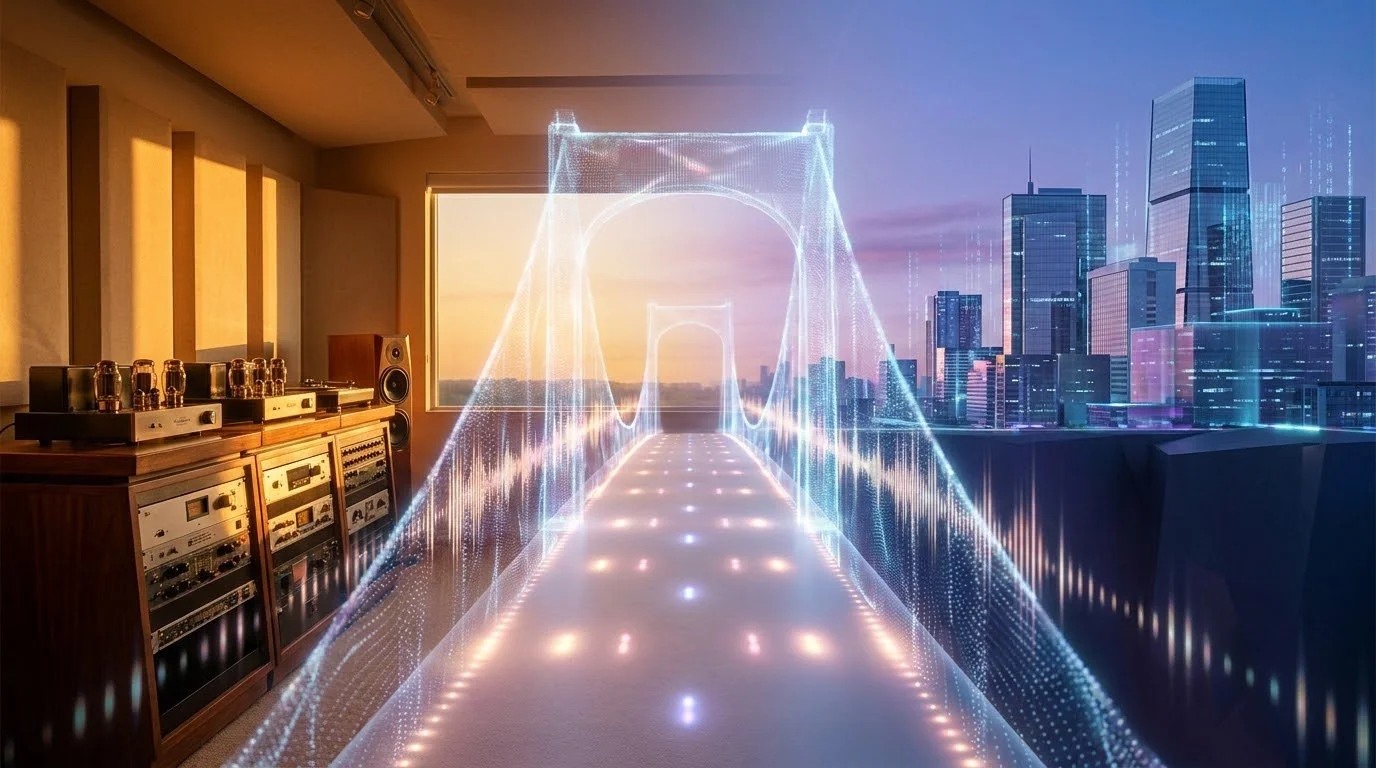
Ultimately, Iron Pen Studios is built on a simple, powerful metaphor: We walk the bridge of access.
       [ INDEPENDENT ARTIST ]                   [ STATE & PUBLIC CHANNELS ]
      Harsh, Sterile Digital Mixes             Demands Rigid Accessibility Compliance
                 │                                        │
                 ▼                                        ▼
    ┌─────────────────────────────────────────────────────────────────────────┐
    │                        THE BRIDGE OF ACCESS                             │
    │  - Forensic Restoration (iZotope RX 12)                                 │
    │  - Tactile Analog Signal Chain ($32k+ Manley & Shadow Hills Hardware)    │
    │  - Turnkey Section 508 Metrology & Cloud-Automated Captions              │
    └─────────────────────────────────────────────────────────────────────────┘
                                         │
                                         ▼
                             [ UNCOMPROMISED TRUST ]
                        Clarity, Security, and Inclusion
On one side of the bridge is the independent creator, facing financial and technical barriers, wondering how to make their music stand out in a noisy digital world. On the other side are municipal agencies, educational institutions, and prime contractors, struggling to navigate complex federal mandates like Section 508 accessibility and ATSC A/85 loudness standards.
We stand in the center. We walk this bridge to connect both sides, helping people who feel uncertain or afraid to cross. Through accessibility (delivering automated captioning and vocal remediation), security (maintaining baseline DCSA FCL readiness and SAM.gov active compliance), and trust (enforcing transparent, productized flat rates and strict, health-protecting 15-hour weekly production boundaries), we help creators and institutions share their stories without compromise.
At Iron Pen Studios, we don't just finish audio tracks. We help you turn the final lock.
Beyond the Decibels: How Metrology and Security Deliver Freedom from Compliance Anxiety
Beyond The Decibels
For Public Information Officers, municipal directors, and agency creative leads, the modern digital landscape is a minefield of quiet anxieties. Every time a new video campaign is uploaded, a public service announcement is broadcast, or an instructional module is launched, an ambient sense of worry lingers in the background.
Will this trigger a digital accessibility audit? Will our media fail a Section 508 compliance check, exposing our organization to severe regulatory penalties and public embarrassment? Will our field audio sound distorted, muddy, or unauthoritative when the community needs to hear us most? Is our sensitive media data safe from cyber-hijacking and data leaks?
At Iron Pen Studios, we believe that professional audio engineering is not just about making a track sound louder. It is about risk mitigation, data governance, and security. True engineering is the process of translating complex acoustic physics and strict computer science into something your organization can feel: absolute peace of mind.
Here is how our uncompromising metrological standards and bank-grade security protocols act as a protective shield, liberating our clients from the fear of operational and compliance failure.
1.0 The Metrology Shield: Eradicating the Fear of Compliance Rejection
In government contracting and high-end commercial broadcasting, close enough is a failure. If your audio files are delivered to public platforms with clipping, digital distortion, or uneven loudness, the hosting network's automated controllers will aggressively compress the signal, ruining the vocal authority of your speaker. Worse, if your files fail to provide accurate, synchronized text transcripts and captions, your organization stands in direct violation of Section 508 and WCAG 2.2 Level AA accessibility standards.
We eliminate this danger through Audio Metrology—the science of precise acoustic measurement. Iron Pen Studios strictly aligns its quality control processes with ISO 9001:2015 (Quality Management Systems) and ISO 10012:2026 (Measurement Management Systems).
Loudness Normalization: We route your audio through physical, stepped-rotary analog outboard hardware—the Manley Massive Passive EQ and Shadow Hills Mastering Compressor Class A—to sculpt your sound stage. We then programmatically analyze the output to guarantee a rock-solid -24 LUFS integrated target matching ATSC A/85 (US) and EBU R128 (International) standards. No digital clipping. No transmission rejection.
Automated Accessibility Integration: The moment your master track is processed, our serverless Google Cloud pipeline handles your vocal transcription natively, outputting synchronized, compliant subtitle files in standard compressed formats.
By treating compliance as a precise mathematical science, we ensure your media passes every automated audit on the first try. You never have to worry about a compliance take-down notice again.
2.0 Cybersecurity as a Sanctuary: Protecting Your Intellectual Property
The modern web browser is the single most vulnerable gateway to your corporate data. Rogue browser extensions, unmanaged password vaults, and loose local file sharing represent immediate dangers to your project’s confidentiality. If a vendor's system is hijacked, your unreleased media, proprietary files, and client metadata are suddenly exposed to the public.
At Iron Pen Studios, cybersecurity is not an afterthought; it is an active, centralized barrier. We govern our local workstation via Google Chrome Enterprise Core, centralizing our security policies directly within our cloud workspace admin panel:
Extension Block Policies: We enforce a strict block-by-default browser environment. Only explicitly allowlisted, verified tools—such as our secure password managers—are physically capable of executing. Malicious keyloggers, session-cookie hijackers, and unvetted tracking scripts are neutralized before they can ever load.
3-Tier Storage & Disaster Recovery: Your master files, session data, and metadata are strictly organized within our 3-Tier APFS Storage Architecture. We utilize local, hardware-encrypted Samsung T7 SSDs synced via Carbon Copy Cloner with SafetyNet disabled to maintain physical offsite backups. This is paired with secure, private, non-public Google Cloud Storage buckets featuring uniform access control. If a natural disaster or hardware failure strikes, your project is restored to an active, secure state in under five minutes.
3.0 Insulating the Workweek: Peak Cognitive Focus
Traditional commercial studios operate on a high-volume grind model. Rushed engineers, working 60-hour weeks under heavy digital strain, routinely overlook micro-clipping, transient distortion, and metadata misalignments.
Iron Pen Studios is built differently. To guarantee zero-defect execution, we cap our active engineering queue at a medically mandated 15 hours per week. Operating from a medical-grade ErgoQuest zero-gravity workstation enclosed within an STC 72 decoupled acoustic shell, our master engineer remains in a state of peak, unhurried cognitive clarity.
Every frequency is analyzed, every transition is verified, and every byte of metadata is audited. We do not rush. We do not fail.
Freedom to Focus on Your Mission
When you partner with Iron Pen Studios, you are not just purchasing audio mastering. You are purchasing freedom from anxiety. You are securing a dedicated technical ally who absorbs your compliance burdens, hardens your data security, and delivers a flawless, authoritative voice for your brand or agency.
Let us handle the metrology, the regulations, and the security. You focus on the art and the mission.